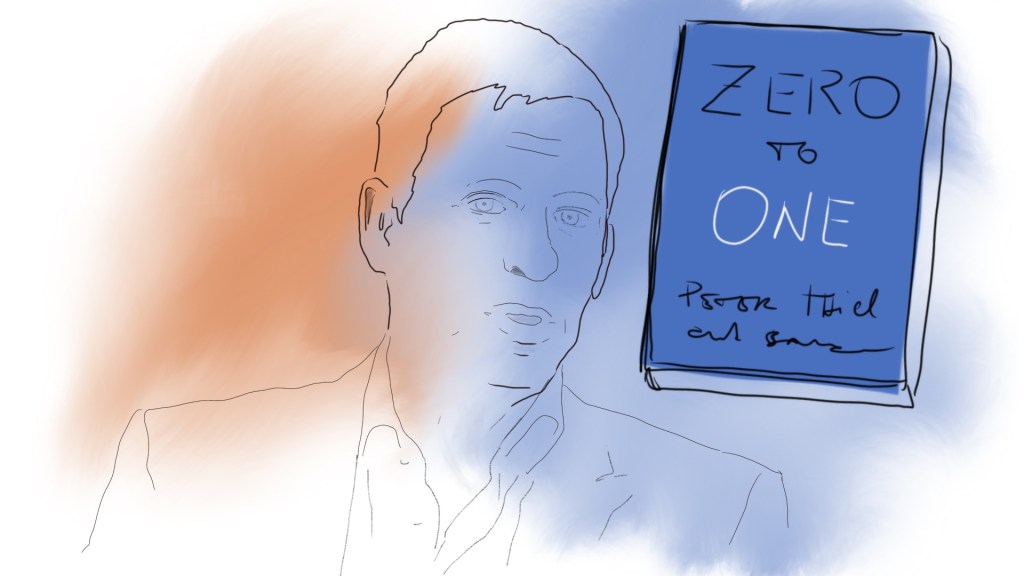
This is a book I enjoyed so much, that I always recommend anyone to read it, especially when I talk to people interested in business or finance. Published in 2014, it is ageing very well. I’m sure “Zero to One” will make you think for a long time.
The author is Peter Thiel, a German American, philosophy and law graduate at Stanford, that became a silicon valley entrepreneur.
Among other things he co-founded PayPal, Palantir Technologies, and Founders Fund. He has a surprisingly entertaining way of telling stories about the economy of the last few decades.
For anyone interested in the world of companies and startups of any size, the author offers some enlightening perspectives and some practical advice
The origin of “Zero to One” dates back to the notes of a course about startups that Peter taught at Stanford in 2012, collected by one of his students, Blake Masters, which in fact appears on the cover as co-author.
The power of secrets
The core message he shares has something to do about innovation, uniqueness, but also commitment and disillusioned understanding of some mechanism of the market.
This sum up even from the meaning of the title, explained in the early pages: in business, many people try to copy from other successful entrepreneurs, or from other companies. That is, their effort is merely an iteration, it is like going from one (the successful example already existing) to 100, or to a generic n-iteration. This way can only lead to a struggle against an already established power.
Instead, what an innovator should strive for is to introduce something truly new to the world, to propose a new horizon, thereby creating a completely exceptional offering in a sea of sameness. This is what it means to go from zero to one: a «vertical», innovative progress, in place of a «horizontal», already seen future. This concept should serve as the driving force for any startup founder.
Peter also mentions ‘secrets’ as the foundation stones of new successful companies. «What is a secret only you and maybe your closest and trusted one know, and believe in?», is a typical question that he would ask to new company founders, in attempt to vet good candidates for growth, from not so promising ones. He would invest in someone who has ‘secrets’, because almost anything that has been invented can’t be invented again.
We probably won’t have a new social network from the next genius, he says, but we can expect something totally different and new. So we need secrets. But people believing in secrets are increasingly scarce. Secrets are risky, people think: things to avoid if you want your money back!
But in the great mysteries of nature and humanity are kept also most treasures.
The fear after the bubble
From this starting point, Peter Thiel begins a brief narrative of recent globalisation. He dwells on the ’90s and the speculative bubbles that have pushed many investors and companies into excesses.
There he gives a magnificent recall of the dot-com mania that distorted the perception of reality, a bubble that peaked in a short period from late 1998 to early 2000, when money was thrown everywhere at any startups that hinted at a possible growth related to the internet.
Even PayPal, which he was running in 1999, was into that climax. But as he tells, at least the company he was guiding had a grandiosity in its mission: to replace the currency of dollars with a virtual one. He explains how the PayPal team devised strategies to attract new customers, gained visibility, and finally received a high valuation of its worth, ultimately securing financing rounds right before the dot-com bubble exploded.
The crash after the dot-com mania was hard for many other companies and individuals, so much so that business thinking has become cautious since then. People and enterprises are scared of new venues, the general principle is nowadays to avoid any risk, make incremental and already tested changes instead.
But Peter has a different opinion of what companies should do, and he suggests that probably the fearful approach to business is likely to lead to the very end that it tries to escape. So be bold instead, let’s go from zero to one!
It is better to be bold, because this is the only way of innovation. But it is also necessary to have a plan, to avoid competition, and to invest in marketing. In fact, the general dangerous trend nowadays is living day by day, the lack of a defined goal being what causes the most harm.
Individuals, businesses, and nations act without a clear objective. To this «indefinite optimism» he opposes a «defined optimism»: have a plan, even a bad one, instead of no plan.
The myth of competition
He then makes perspicacious observations, taking examples from the real world, disassembling some established ideas about business and economics.
The first to fall is the myth of competition, considered the perfect situation in economy as it is taught in schools. But competition depletes companies of energies and money. A wise startup avoids competition, at all costs.
Competing in a highly saturated market (Peter Thiel often refers to the example of restaurants) will throw a company in an endless race to survive. Academies and universities are such other examples where competition is fierce, but that’s because the stakes are so small, states the author, and I totally agree with him on that.
And there comes a second myth: that a monopoly is bad in any case. (He is discussing the issue from an internal point: the point of view of companies, leaving for other venues the debate about god versus bad influence of monopoly for society and economy at large).
It is easy to show how the companies caught up in the race for competition strive to present themselves as genuine small monopolies, in the eyes of the customers. But they are just competing, struggling companies.
Whereas, on the contrary, monopolies like high tech and informatics giants try to disguise themselves as multiple companies offering different products. In fact, they are true monopolies, offering unique services and products.
That apparent contradiction dissipates once one understand that a monopoly, far from being an aberration in the market, often emerges as a natural consequence of genuine innovation and unparalleled success in delivering and capturing value. It is refreshing to look at companies through this lens: of innovation and value creation.
Even for individuals this message can apply, though Peter Thiel is fond of start ups and all the creativity that arise from a coordinated effort, a team endeavour within a small group, akin to that of a company or industry.
Try to be a monopoly, in your own business, which emerges as a natural consequence of entrepreneurial ingenuity and pursuit of excellence, and avoid competition.
Only companies can aim for innovation
Start ups are really collaborative beasts. Peter stresses the point that an individual can create only so much, like a unique work of art, like a novel or similar iconic work, but to really build something with a vision, something that has a wider impact, it is mandatory to create a company.
He calls a startup «the large group of people you can convince of a plan to build a different future».
I’ve always had this hidden dream of starting my own company someday. Don’t you? So I know many people will find inspiration in this book.
Business owners or start up aspiring founders will find great advice, for example about what it means to have a company, and about some of the key concepts of marketing.
Stock trading enthusiasts will be delighted reading from the author about recent and manifest examples on how markets go through phases of excitement – or bubbles – and recessions.
But the companies who stay afloat and prosperate are the ones who have values and a solid vision for the future. In short terms, they have a plan.
Hearing more from Peter Thiel
The only drawback of this book is that it hasn’t a sequel, or some hundreds pages more. Yes because once finished the book, I’d like to know and hear new principles and have more instructions from the author.
Wishing to hearing more, you can listen to some of the many lectures given by Peter Thiel, readily available on YouTube, where he often reiterates his core messages.
For me, this book has been incredibly useful, providing with many insights into the world of both large and small businesses.
Of course, I’m aware of my adoration and reverence for this book. But perhaps I find it so fascinating and captivating because – for now – the world of companies is distant to me. Until, some day, I’ll have my own company… 😉
Maybe one could try to find weaknesses in the author’s clear and well-articulated principles, seeking exceptions to the rules he gives, but honestly, I haven’t found any or don’t know of any.
The approach to business suggested by the author is typical of bold innovators, but I would also like to say that it is not at all confrontational or unkind. Rather, it’s full of good intentions, spirit of collaboration, and a desire to improve the world.
“Zero to One” remains a little gem in the collection of business books.






 Money Plato
Leave a comment